
Synthetic pentadecapeptide reference material
BPC-157 supplied as lyophilized reference material for in-vitro assay work. Laboratory research use only.
- Compounds
- 1
- Purity
- 99.96%
- Certificates
- 1
- Method
- LCMS-UV
1 compound in this line
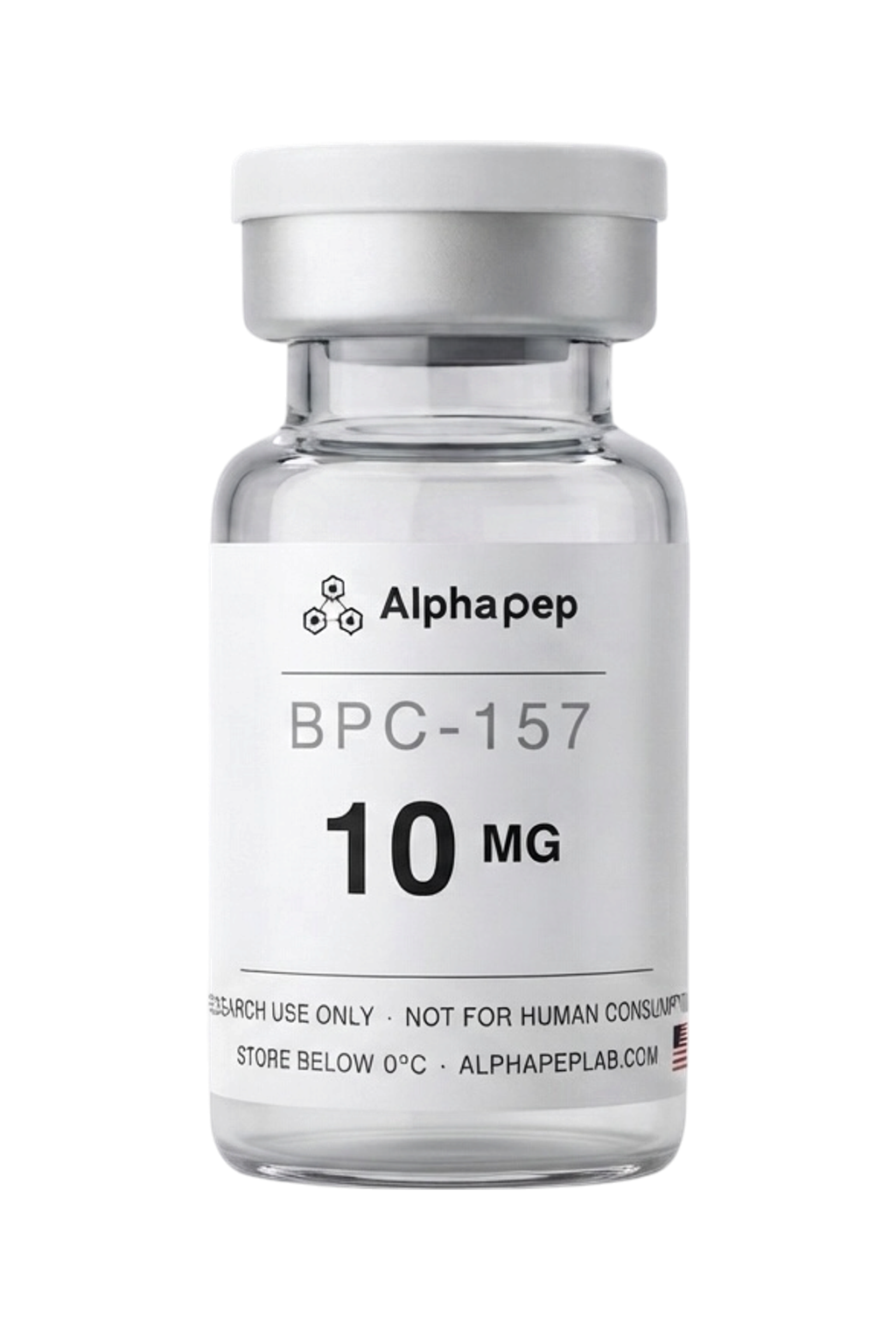
What the molecule is
BPC-157 is a synthetic peptide of fifteen amino acids whose sequence corresponds to a fragment identified in gastric juice. It is supplied here as a characterised reference standard: a molecule of known identity and measured purity against which an experiment can be run. Alphapep makes no representation about what it does in any system, and offers it for no purpose other than in-vitro laboratory research.
- Formula
- C62H98N16O22
- Mass
- 1,419.6 Da
- Supplied as
- 10mg
Analytical specification
The lot supplied is assayed by an independent laboratory by LCMS-UV. Purity is reported as UV peak-area percentage; identity is confirmed separately by matching the measured mass of the principal peak against the calculated mass for the sequence. A certificate tied to that lot accompanies the vial, and the same document is published on this site before an order is placed.
No family assignment, and that is a finding
InterPro, Pfam and UniProt record no domain, family or clan assignment for the sequence catalogued in this line. The absence is a result rather than a gap: the sequence is short, synthetic, and not homologous to any described domain, so there is nothing for a classification database to record.
All three resources index protein domains by sequence homology, and all three were checked. None returns an entry for this sequence.
What would qualify for this line
Membership is therefore defined by what a sequence is, not by which database it falls into. What is grouped here are short unmodified peptides supplied as lyophilised reference material, with free termini, no lipidation, no terminal capping and no disulfide bridge, each accompanied by a lot-matched certificate from an independent laboratory.
- Compounds
- 1
- Assay method
- LCMS-UV
- Laboratory
- ACS Peptide Testing Labs
- Certificate date
- 2026-07-28
- Appearance
- White powder
How specific that gets in practice
The compound presently catalogued shows how far that description can be taken. Four of its fifteen positions are proline, three of them consecutive, which restricts backbone rotation and produces cis/trans isomerism visible chromatographically as peak broadening rather than as a second species. It contains no tryptophan, tyrosine or phenylalanine, so it has no 280 nm chromophore and must be quantified at 214 nm against the amide bond. And it contains no cysteine, which removes disulfide-linked dimers from the impurity profile entirely and leaves deletion and truncation sequences as the principal related substances.
Percentage of total UV peak area attributable to the target compound.
Measured mass of the principal peak against the calculated mass for the sequence.
Each certificate is issued against a specific accession, not against the compound.