Copper-binding tripeptide reference material
GHK-Cu supplied as lyophilized reference material for in-vitro work. Laboratory research use only.
- Compounds
- 2
- GHK-Cu lot
- 99.74%
- Certificates
- 2
- Method
- LCMS-UV
2 compounds in this line
What the molecule is
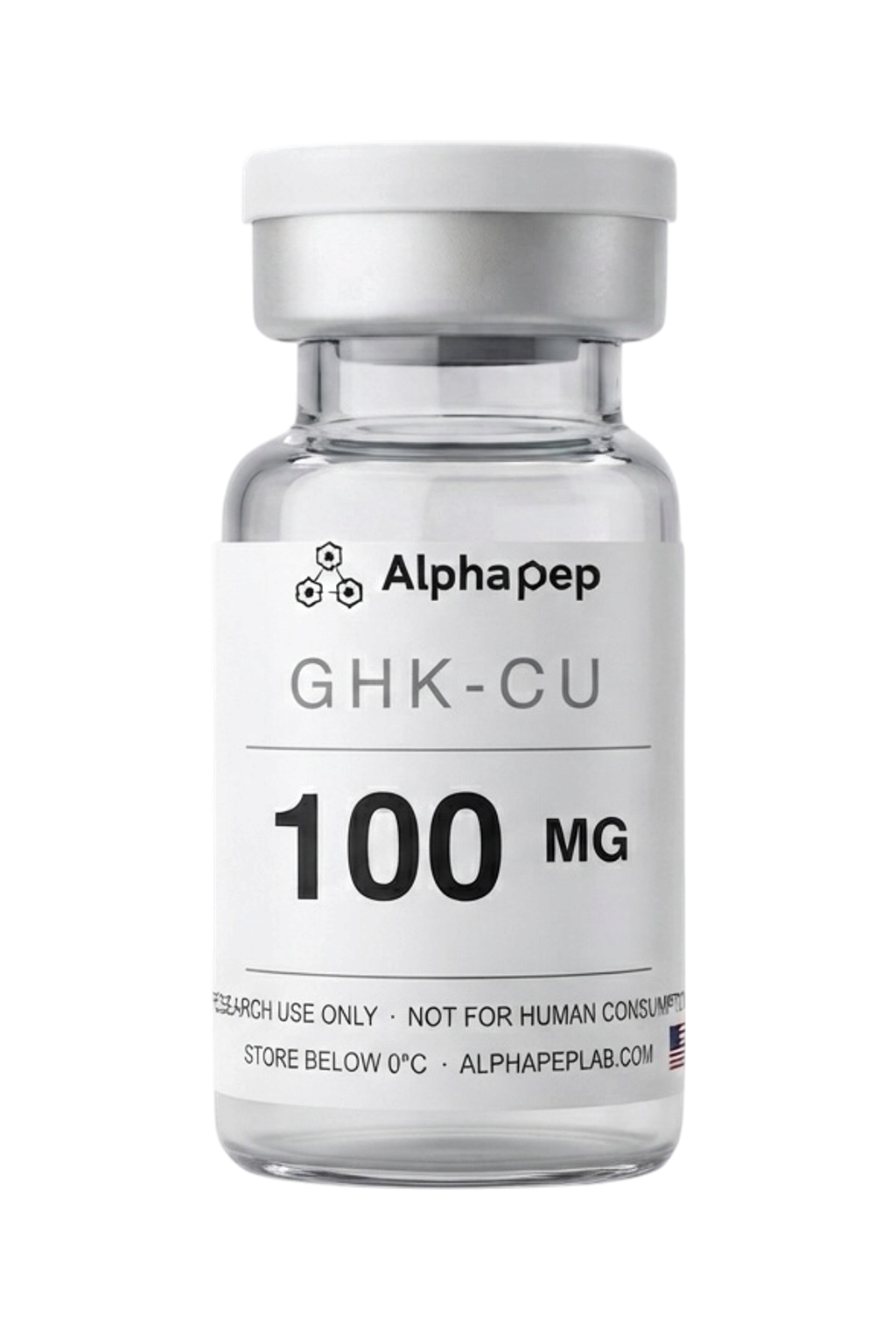
GHK is a tripeptide of glycine, L-histidine and L-lysine. In the copper form supplied here it is complexed with copper(II), and that coordination is what gives the powder its characteristic purple colour: a visible property of the complex rather than an additive. It is supplied as a characterised reference standard for in-vitro coordination and cell-culture work, and for no other purpose.
- Formula
- C14H23CuN6O4
- Mass
- 402.9 Da
- Supplied as
- 100mg
Composition of the blend, not an overall purity figure.
Analytical specification
The lot is assayed by an independent laboratory by LCMS-UV, reporting purity as UV peak-area percentage and confirming identity by mass. Appearance is recorded on the certificate as well, which for this compound is a meaningful check: the purple colour is a direct consequence of the copper complex being intact.
A coordination grouping, not a sequence family
This line is defined by coordination chemistry rather than by sequence homology, and it is not a recognised structural family. InterPro, Pfam and UniProt classify proteins by sequence relationship; a copper complex of a tripeptide has no homology to record, and the tripeptide is far shorter than any domain model describes.
Checked against the peptide, not against the complex. These resources index sequence, and a coordination geometry is not a sequence feature.
What the members share comes from the metal
A copper(II) centre held in a nitrogen-donor environment produces a broad d-d absorption band in the visible region near 600 to 640 nm, which is why materials of this type are coloured while metal-free peptides are not. That band is also a rapid check that the metal is bound rather than present as a free salt alongside uncomplexed peptide, and the natural copper isotope pattern, 63Cu to 65Cu at roughly 69 to 31, gives the mass spectrum a confirmatory signature that a copper-free impurity cannot reproduce.
- Compounds
- 2
- Assay method
- LCMS-UV
- Laboratory
- ACS Peptide Testing Labs
- Certificate date
- 2026-07-28
- Appearance
- Purple powder
The variability is the boundary
Where the coordinating histidine sits in the chain determines the donor arrangement, so two peptides binding the same metal need not present the same geometry. Stoichiometry varies as well: the same ligand and metal are catalogued both as one-to-one and as two-to-one complexes, which are compositionally different species of different mass, and catalogue entries in this area are not consistent about which they mean.
Percentage of total UV peak area attributable to the target compound.
Measured mass of the principal peak against the calculated mass for the sequence.
Each certificate is issued against a specific accession, not against the compound.