Laboratory reagents and consumables
Consumables kept alongside lyophilized reference material. Laboratory research use only.
- Compounds
- 1
- Preservative
- —
- Certificates
- 0
- Method
- LCMS-UV
1 compound in this line
What is supplied
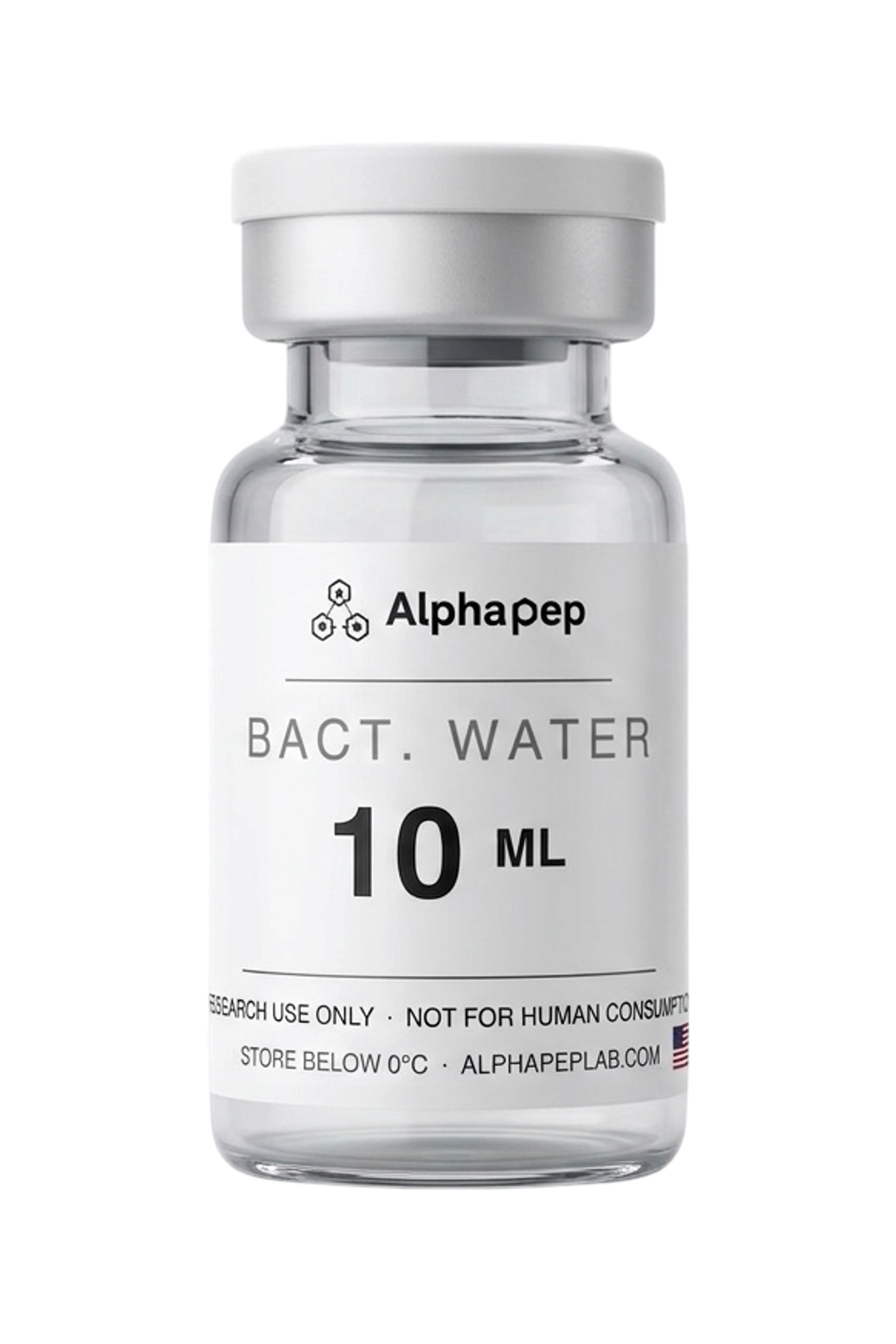
This line covers the consumables a bench keeps alongside lyophilized reference material. What is currently catalogued is a preserved aqueous solution, stocked the way glassware and reagents are stocked: as a supporting consumable, not as a product with an application of its own.
- Formula
- H2O + 0.9% C7H8O
- Mass
- 18.015 Da
- Supplied as
- 10ml
Specification
The solution is water containing 0.9% benzyl alcohol as a preservative, supplied in a sealed multi-dose vial. The benzyl alcohol is the whole of the difference between it and water. Which reagents a given assay calls for is determined by the protocol and by the laboratory performing the work.
What this line is, and what it is not
This line holds laboratory reagents rather than compounds under study, and it is not a structural family in any sense. Its contents are not peptides, carry no sequence and have no entry in the protein classification databases, so the family fields that apply elsewhere in this catalogue are empty here by nature.
No query applies. A classification database takes a sequence as input, and this line supplies none.
Described by composition
The reagent supplied is water preserved with 0.9% benzyl alcohol, presented in multi-dose vials. The benzyl alcohol is the whole of the difference between it and water: it is a preservative, and its presence is what the label records.
- Compounds
- 1
- Assay method
- LCMS-UV
- Laboratory
- —
- Certificate date
- —
- Appearance
- —
Why the rest of the catalogue's apparatus does not transfer
Because there is no peptide, there is no sequence to reconstruct, no residue composition to sum against a deposited formula, no chromophore to quantify at 214 or 280 nm and no oxidation profile to resolve. The certificate that accompanies a peptide lot answers questions this material does not raise.
Percentage of total UV peak area attributable to the target compound.
Measured mass of the principal peak against the calculated mass for the sequence.
Each certificate is issued against a specific accession, not against the compound.