
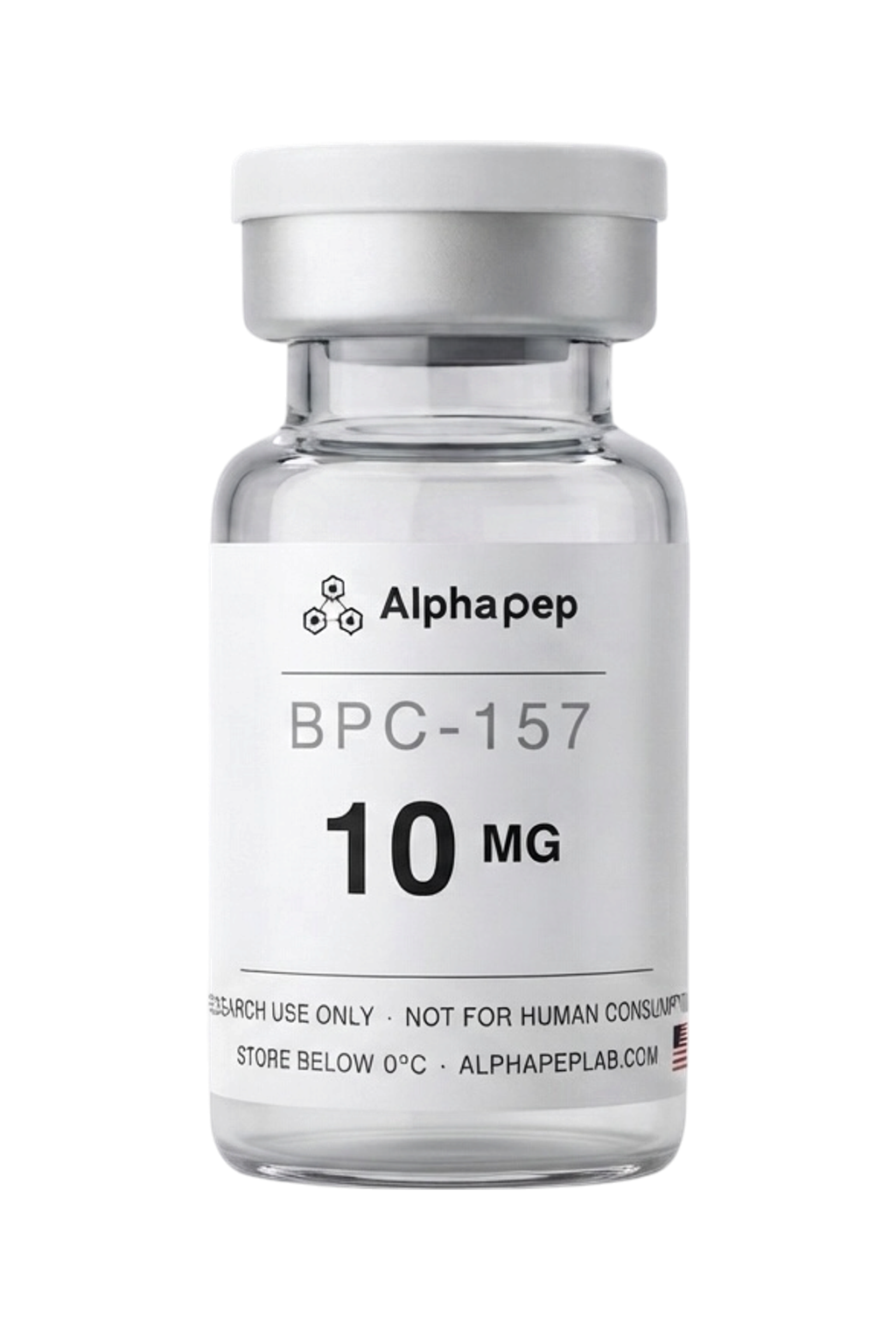
BPC-157
Pentadecapeptide — 15 amino acids
C₆₂H₉₈N₁₆O₂₂ · 1,419.6 Da
Synthetic pentadecapeptide derived from the gastric protein BPC. Exhibits pleiotropic activity through interaction with the NO-system and growth factor signaling pathways.
- Form
- Lyophilized powder
- Purity
- 99.96%
- Stock
- In stock
- Sizes available
- 10mg
Specification
- Sizes available
- 10mg ($79.95)
- Form
- Lyophilized powder
- Category
- Peptide Fragments
- Molecular class
- Pentadecapeptide — 15 amino acids
- Molecular formula
- C₆₂H₉₈N₁₆O₂₂
- Molecular weight
- 1,419.6 Da
- Purity
- 99.96%
Certificate of Analysis
- Test Method
- LCMS-UV
- Laboratory
- ACS Peptide Testing Labs
- Test Date
- 2026-07-28
Composition, targets and analytical record
The structural record for the material as supplied, and the analytical figures returned for the lot on the certificate.
BPC-157 is a synthetic pentadecapeptide of molecular formula C₆₂H₉₈N₁₆O₂₂, with an average molecular mass of 1419.56 Da and a monoisotopic mass of 1418.7042 Da. Its sequence is Gly-Glu-Pro-Pro-Pro-Gly-Lys-Pro-Ala-Asp-Asp-Ala-Gly-Leu-Val. The molecule is unmodified: a free N-terminal amine, a free C-terminal carboxylic acid, no lipidation, no terminal capping, no cyclisation and no disulfide bridge. Summing the fifteen residue compositions with a single water of hydrolysis reproduces the deposited formula atom for atom, so the sequence and the absence of any covalent modification are mutually confirming.
- 1Gly
- 2Glu
- 3Pro
- 4Pro
- 5Pro
- 6Gly
- 7Lys
- 8Pro
- 9Ala
- 10Asp
- 11Asp
- 12Ala
- 13Gly
- 14Leu
- 15Val
Three compositional features govern how the peptide is characterised. First, four of the fifteen positions are proline, at positions 3, 4, 5 and 8, three of them consecutive. Such polyproline runs restrict backbone rotation and support cis/trans amide isomerism, which is observed chromatographically as peak broadening or partial splitting rather than indicating a second species. Second, the sequence contains no tryptophan, tyrosine or phenylalanine. With no aromatic chromophore the molecule has negligible absorbance at 280 nm, and ultraviolet quantification must be carried out at 214 nm against the amide bond; a 280 nm assay would register essentially nothing. Third, the absence of cysteine excludes disulfide-linked dimers from the impurity profile altogether, leaving deletion and truncation sequences as the principal related substances.
One glutamate and two aspartate residues against a single lysine give a net acidic charge and a low isoelectric point, so the peptide is retained under ion-pairing reversed-phase conditions and elutes early relative to basic peptides of comparable mass.
Neither UniProt nor ChEMBL records a receptor or protein target for this sequence, so that field is left empty. It is distinguished from other short synthetic peptides of similar mass by its proline density and by the complete absence of aromatic and sulfur-containing residues, a combination that is unusual and makes its ultraviolet and mass spectra readily diagnostic.
Analytical specification
ACS Peptide Testing Labs · 2026-07-28 · AAHW067The lot supplied for BPC-157 was assayed by ACS Peptide Testing Labs on 2026-07-28 under accession AAHW067. Purity is reported as 99.96% by LCMS-UV, expressed as the percentage of total UV peak area attributable to the target compound. Identity is a separate determination and was returned as: Confirmed (LCMS-UV mass ID). A sample can be highly pure and still be the wrong molecule, which is why both results appear on the certificate.
The material was recorded as White powder. The sequence corresponds to a molecular formula of C₆₂H₉₈N₁₆O₂₂ and a calculated mass of 1,419.6 Da.
Endotoxin was outside the scope of this assay and is reported as N/A. Peak-area percentage is also not the same as absolute mass purity: material that does not absorb at the detection wavelength is not represented in the figure.
References
In-vitro and preclinical literature. These are provided as reading for laboratory context and are not claims about the material.
This material is supplied strictly for in-vitro laboratory research. It is not a drug, food or supplement, and is not for human or veterinary use, diagnosis, or consumption.
Related compounds
View catalog
Retatrutide
15mg · Lyophilized powder
Tirzepatide
10mg · Lyophilized powder
Tesamorelin
10mg · Lyophilized powder
NAD+
1000mg · Lyophilized powder