
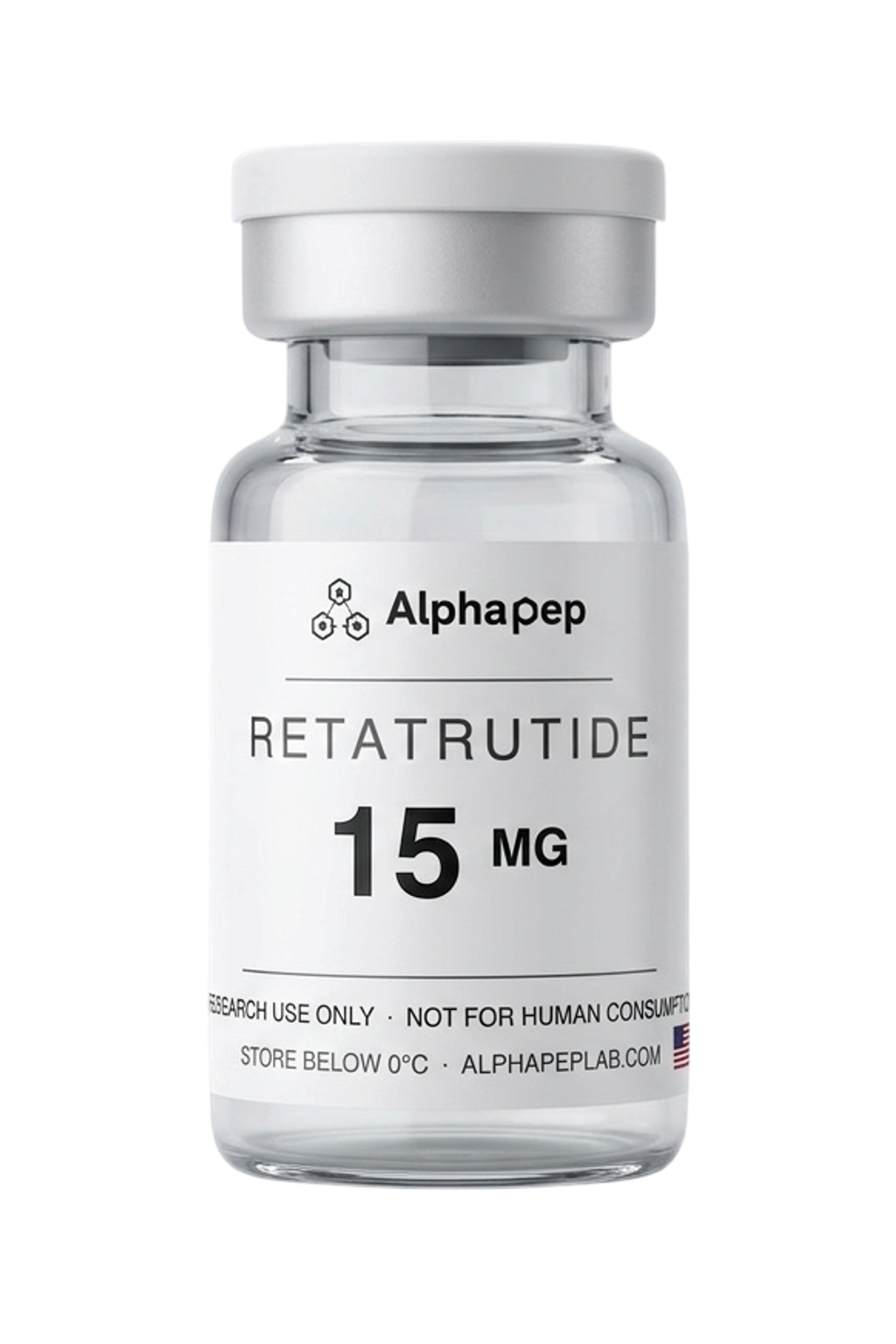
Retatrutide
Triple GLP-1/GIP/Glucagon Receptor Agonist
C₂₂₁H₃₄₂N₄₆O₆₈ · 4,731.4 Da
Triagonist peptide activating GLP-1, GIP and glucagon receptors simultaneously through distinct binding mechanisms at each receptor subtype.
- Form
- Lyophilized powder
- Purity
- 99.96%
- Stock
- In stock
- Sizes available
- 15mg
Specification
- Sizes available
- 15mg ($142.95)
- Form
- Lyophilized powder
- Category
- Metabolic Research
- Molecular class
- Triple GLP-1/GIP/Glucagon Receptor Agonist
- Molecular formula
- C₂₂₁H₃₄₂N₄₆O₆₈
- Molecular weight
- 4,731.4 Da
- Purity
- 99.96%
Certificate of Analysis
- Test Method
- LCMS-UV
- Laboratory
- ACS Peptide Testing Labs
- Test Date
- 2026-07-28
Composition, targets and analytical record
The structural record for the material as supplied, and the analytical figures returned for the lot on the certificate.
Retatrutide is a synthetic 39-residue peptide of molecular formula C₂₂₁H₃₄₂N₄₆O₆₈, with an average molecular mass of 4731.42 Da and a monoisotopic mass of 4728.4718 Da. The chain opens Tyr-Aib-Gln-Gly-Thr-Phe-Thr-Ser-Asp-Tyr and closes Gly-Ala-Pro-Pro-Pro-Ser, the C-terminus being an amide rather than a free acid. Three positions depart from the twenty proteinogenic amino acids: alpha-aminoisobutyric acid occupies positions 2 and 20, and an alpha-methylated leucine occupies position 13. These alpha,alpha-disubstituted residues are introduced during solid-phase assembly and are resolved analytically by their mass increments relative to the corresponding proteinogenic residues.
- 1Tyr
- 2Aib
- 3Gln
- 4Gly
- 5Thr
- 6Phe
- 7Thr
- 8Ser
- 9Asp
- 10Tyr
- 11–12⋯
- 13α-Me-Leu
- 14–16⋯
- 17Lys
- 18–19⋯
- 20Aib
- 21–22⋯
- 23Ile
- 24Glu
- 25Tyr
- 26Leu
- 27Leu
- 28Glu
- 29–33⋯
- 34Gly
- 35Ala
- 36Pro
- 37Pro
- 38Pro
- 39Ser
A single lipid substituent is carried on the epsilon-amine of Lys17. It comprises an eicosanedioic (C20 alpha,omega-dicarboxylic) acyl group joined through a gamma-glutamate spacer and one 2-[2-(2-aminoethoxy)ethoxy]acetyl (AEEA) unit, contributing C₃₁H₅₄N₂O₉ to the intact formula. The unmodified 39-residue backbone corresponds to C₁₉₀H₂₈₈N₄₄O₅₉; the difference between that composition and the intact molecular formula is the diagnostic signature of the acyl-spacer assembly, and reconstructing it from the sequence reproduces the deposited formula exactly.
The compound sits among the incretin-family peptide analogues built on the glucagon/secretin peptide fold. Three receptor entries are named against it: the gastric inhibitory polypeptide receptor (UniProt P48546), the glucagon-like peptide 1 receptor (UniProt P43220) and the glucagon receptor (UniProt P47871).
Retatrutide is distinguished from tirzepatide, its closest structural relative, on four counts: the acyl chain is attached at Lys17 rather than Lys20; the spacer carries one AEEA unit rather than two; position 13 is alpha-methyl-leucine rather than alpha-aminoisobutyric acid; and the segment spanning positions 23 to 28 reads Ile-Glu-Tyr-Leu-Leu-Glu in place of Val-Gln-Trp-Leu-Ile-Ala. The two compositions differ by C₄H₆N₂, a separation of 82.11 Da in average mass that is unambiguous by electrospray mass spectrometry.
- Acyl chain attachment
- RetatrutideLys17
- TirzepatideLys20
- AEEA units in spacer
- Retatrutide1
- Tirzepatide2
- Position 13
- Retatrutideα-methyl-Leu
- TirzepatideAib
- Positions 23–28
- RetatrutideIle-Glu-Tyr-Leu-Leu-Glu
- TirzepatideVal-Gln-Trp-Leu-Ile-Ala
Analytical specification
ACS Peptide Testing Labs · 2026-07-28 · AAHW060The lot supplied for Retatrutide was assayed by ACS Peptide Testing Labs on 2026-07-28 under accession AAHW060. Purity is reported as 99.96% by LCMS-UV, expressed as the percentage of total UV peak area attributable to the target compound. Identity is a separate determination and was returned as: Confirmed (LCMS-UV mass ID). A sample can be highly pure and still be the wrong molecule, which is why both results appear on the certificate.
The material was recorded as White powder. The sequence corresponds to a molecular formula of C₂₂₁H₃₄₂N₄₆O₆₈ and a calculated mass of 4,731.4 Da.
Endotoxin was outside the scope of this assay and is reported as N/A. Peak-area percentage is also not the same as absolute mass purity: material that does not absorb at the detection wavelength is not represented in the figure.
References
In-vitro and preclinical literature. These are provided as reading for laboratory context and are not claims about the material.
- 01PubChem CID 171390338 — Molecular formula C221H342N46O68; Average and monoisotopic masses computed from the PubChem molecular formula using IUPAC standard atomic weights and principal isotope masses
- 02PubChem CID 171934787 — Same formula deposited under the sodium salt record
- 03ChEMBL CHEMBL5095485 — Primary sequence and positions of the four modified residues; Synonyms LY3437943 and LY-3437943
- 04UniProt P48546 — Target name: gastric inhibitory polypeptide receptor
- 05UniProt P43220 — Target name: glucagon-like peptide 1 receptor
- 06UniProt P47871 — Target name: glucagon receptor
This material is supplied strictly for in-vitro laboratory research. It is not a drug, food or supplement, and is not for human or veterinary use, diagnosis, or consumption.
Related compounds
View catalog
Tirzepatide
10mg · Lyophilized powder
BPC-157
10mg · Lyophilized powder
Tesamorelin
10mg · Lyophilized powder
NAD+
1000mg · Lyophilized powder